


Good evening,
Today, Ethereum developers agreed on a tentative date to activate the Glamsterdam upgrade on their first public testnet, Sepolia. Like the decision made on last week’s ACD call, this decision comes with a few important caveats.
Also, stay tuned for a new Ready for Merge podcast episode coming out tomorrow. The episode covers everything you need to know about Season 2 of the show.
Let’s get into it.
Yours truly,
Christine D. Kim
🌕 To get early access to this week’s ACD After Hours newsletter, make sure you are signed up for a premium subscription:
🌓 Interested in being a featured sponsor of this newsletter? Learn more about sponsorship opportunities available for ACD After Hours:
🌑 I also run a research and advisory firm called Protocol Watch for businesses building on Bitcoin and Ethereum. Learn more about how I can help your business stay ahead of protocol changes:
The shot 🥛
The chaser 🍪
Ethereum developers have tentatively set a date to activate the Glamsterdam upgrade on their first public testnet, Sepolia.
Today, developers agreed to schedule Glamsterdam on Sepolia on October 6 at 13:53 UTC.
Like last week’s decision to schedule for inclusion (SFI) Frame Transactions in the Hegota upgrade, this decision comes with a few important caveats.
Caveat #1: No stable devnets
The first is that there are still no stable devnets.
Developers set the date for Sepolia without having implemented a version of Glamsterdam successfully on any private testnet.
The most recent developer-focused testnet, also called devnet, was launched earlier this week. Glamsterdam-Devnet-9 was launched on Tuesday, Sept 1, with 1,000 validator nodes, the largest devnet spun up for Glamsterdam so far by node count.
Developers had been hoping this would be the last devnet before public testnet upgrades. However, the network is not currently finalizing, meaning it is operating at reduced security due to a lack of validators correctly proposing and attesting to the chain head.
Ethereum Foundation developer operations engineer Stefan Starflinger said at today’s All Core Developers (ACD) meeting, ACDC 186:
Having such a big network really showed that there are still quite a few edge cases and issues that we need to address.
Starflinger then added that a major bug was discovered in consensus layer (CL) clients on the prior devnet, Glamsterdam-Devnet-8. He said:
For Devnet-8, there was a big finding as well. If you would propose a block with the same has as the parent, you could get the whole network to stop.
On the execution layer (EL) side, Ethereum Foundation researcher Maria Silva shared that a bug was also discovered in EIP-8037, State Creation Gas Cost Increase, requiring all EL clients to update their implementations.
Due to these bug fixes in clients, which also require specification changes in Glamsterdam, developers will be launching another devnet, Glamsterdam-Devnet-10, in the coming weeks.
If stable, this will also be the venue where Layer-2 and staking protocols can safely test their applications before the Sepolia upgrade on October 6.
If Devnet-10 is unstable and developers once again find major bugs in the upgrade, they may reschedule the Sepolia upgrade and delay it until they can successfully activate the upgrade.
Ethereum Foundation developer operations engineer Parithosh Jayanthi, who was also chairing this week’s ACD call, ACDC #186, said:
If Devnet-10 fails, then we’d have to take it case by case, but yeah, I doubt any client would make a release in the next week, so worst case, we can discuss it on ACDT or ACDE [next week] about not doing the fork at that time [on Oct 6], especially if we find particular issues that would take longer to resolve.
Caveat #2: No timelines yet for Hoodi or mainnet
Because of the circumstances surrounding the October 6 date for Sepolia, developers agreed to hold off on setting any dates for the second public testnet upgrade on Hoodi.
Enrico del Fante, a Teku client developer at Consensys, said:
I feel like having just Sepolia and waiting for a couple of weeks more to set Hoodi in stone would be wise, considering we had some issues lately [on Devnet-9] and stuff like that.
Also, while developers are still hopeful about scheduling a mainnet upgrade before the end of the year, setting a date for Sepolia has not made them any more confident that this timeline will hold.
Scheduling Sepolia no later than October 6 leaves developers a small window of opportunity to still ship the upgrade on Ethereum mainnet in December, but it does not increase the odds of this happening, as nothing has yet to suggest that client implementations are mainnet-ready.
Bottom line
The good news is that bugs are being caught and patched during the testing process for Glamsterdam. That is exactly what devnets are for. In an era of artificial intelligence, when the attack surface for software—especially something as complex as the Ethereum protocol—is growing larger and deeper, it is no surprise that developers are finding more bugs and needing more time than anticipated to battle-test this upgrade.
What this means for the Ethereum ecosystem and for stakeholders anticipating Glamsterdam’s features and scaling benefits is less predictability in the upgrade activation process. It is not yet clear when Hoodi will follow Sepolia, or when mainnet could arrive after that. Developers agreed to upgrade Sepolia on October 6, but even this date could change depending on how things go in the weeks ahead, specifically the Glamsterdam-Devnet-10 launch.
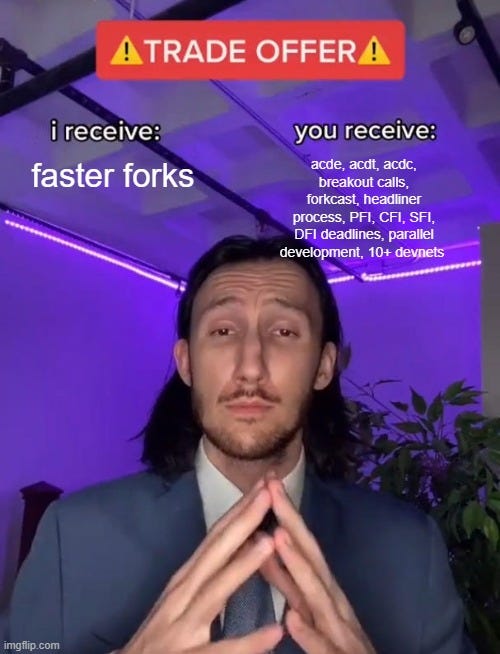
Ethereum development has never been predictable, but one thing it used to be was predictably slow. Over the past year or so, as developers have pushed aggressively to upgrade Ethereum on a more regular and ambitious cadence, once every six months, much of the development process has changed in the name of speed and become more unpredictable.
I covered these changes in the development and governance process extensively in this newsletter. Much of my writing on this topic was shared in the fall of last year, when developers were preparing the Fusaka upgrade for mainnet activation.
Developers successfully shipped Fusaka last December on the Ethereum mainnet and, in doing so, met their target of two upgrades in one year. This year, that same ambition and drive may also result in a Glamsterdam activation on Ethereum this December, bringing greater scalability, an improved user experience, and more features for the Ethereum ecosystem to enjoy sooner rather than later.
The downside, though, is that the ecosystem must be more alert, more aware, and more involved in core protocol development than ever to stay afloat with faster-moving upgrade timelines that may change on short notice.
Given the benefits contained in each upgrade, perhaps that is not such a bad trade-off for the ecosystem.
(It’s certainly good for me, as a businesswoman whose entire MO is demystifying the development and governance of public blockchains like Ethereum. :P
Speaking of which, if you are a business building on Ethereum and would like to learn more about the advisory services I offer, please visit the Protocol Watch site and use the inquiry form there. I look forward to hearing from you!)
Temperature check 🗳️
Q: What is your S-tier EIP for Hegota that has not yet been SFI’d?
R: A tie between EIP-8198 (Quick slots), EIP-8363 (Tapered issuance burn), and something else.
Further reading 🛋️
All Core Developers Consensus #186 call summary and transcript (Forkcast).
Protocol Guild coordinator Trent van Epps shares an updated diagram of the fiscal entities and funded teams that collectively support Ethereum core protocol development and research (X).
Ethereum Foundation research coordinator Will Corcoran discusses the layers of Ethereum governance and the risks of capture to each (X).
Ethereum Cat Herders President Pooja Ranjan reflects on the evolving role of the ACD call chairs in the Ethereum governance process (Etherworld).
For a comprehensive overview of the Ethereum governance process, check out the posts in the ACD Toolkit.
The Ethereum Foundation highlights development milestones achieved across the Ethereum ecosystem in August (X).
🙂 Thank you for reading! What did you think of today’s issue? Please share your feedback by leaving a comment.
😁 If you like what you read today, consider sharing it with a friend who might also enjoy the content.
🥳 Finally, if you’re a premium subscriber, don’t forget to join the subscriber chat. It’s an exclusive space to discuss and debate the future of Ethereum and Bitcoin with fellow readers and yours truly.

If slower development could make client development less costly, and thus enable more part-time or hobby projects, then maybe slower development could be a good thing?
And if the goal is ossification, slower development could be a step towards that goal